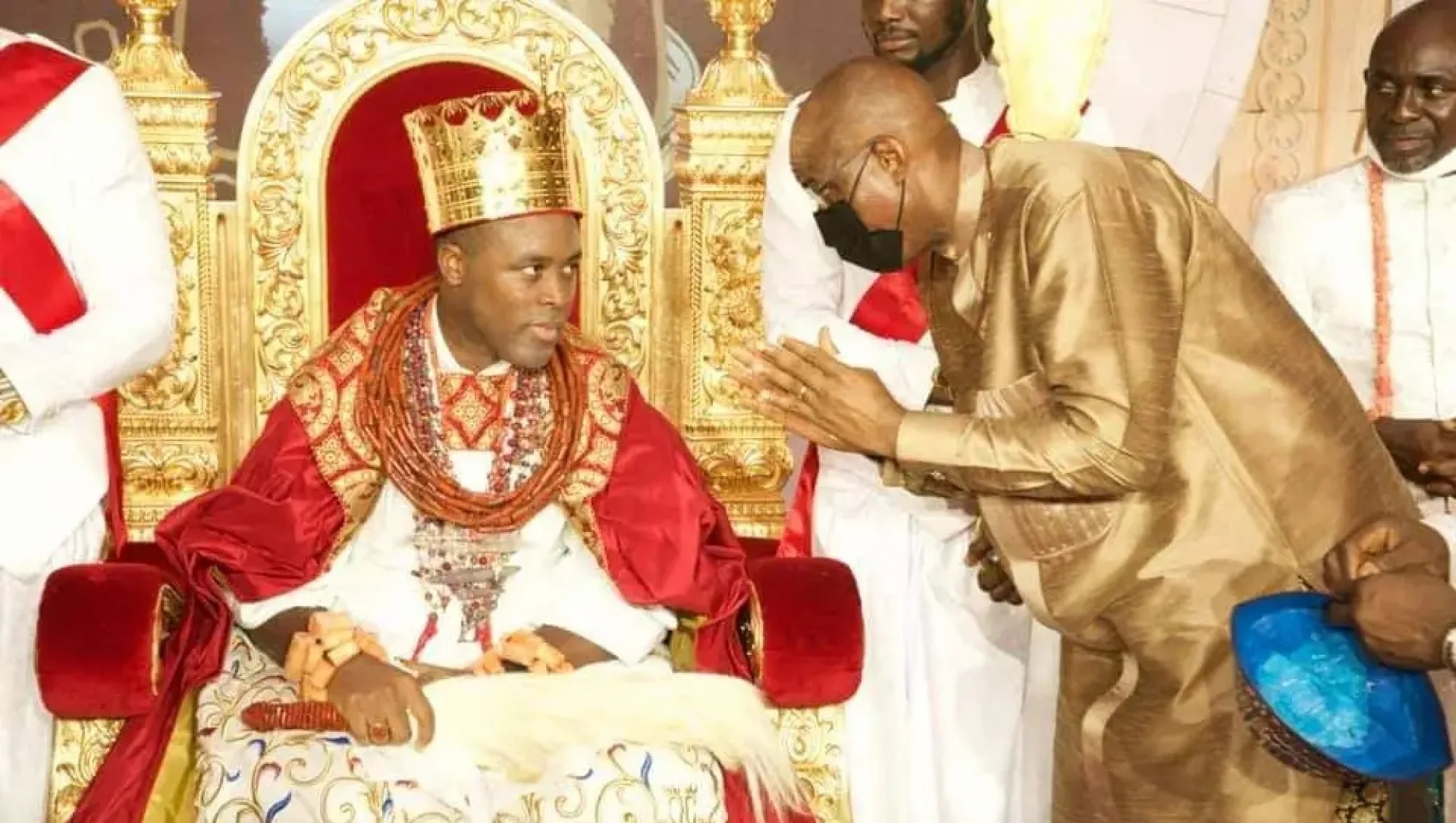
THE ITSEKIRI
15th Edition of the Encyclopedia Britannica Volume 6, page 436:
“Itsekiri, also called JEKRI, ISHEKIRI, or OUWERRI, ethnic group inhabiting the westernmost part of Niger Delta of Nigeria. The Itsekiri make up an appreciable proportion of modern towns of Sapele, Warri, Burutu and Forcados. They speak a dialect of Yoruba, and share elements of culture with Yoruba, Edo, Urhobo and Ijaw through a variety of contacts.
“The Itsekiri are a coastal people, primarily fishermen, and have employed traps, fences, and nets, as well as rod and line techniques. Women make mats and baskets from reeds and palm materials. Silversmithing has died out and blacksmithing has declined.
“Myths of origin establish that Ginuwa, the Itsekiri founder and first Olu (king), came from Benin, so that subsequent kings are descendants of the Oba of Benin. Lesser Chiefs once met as a council and advised the Olu. Chieftaincy is being redefined in conformity with modern government, and some settlements do not participate in chieftaincy at all.
“Within settlements, adult males trace patrilineal descent from settlement founders. In broader context, the Itsekiri claim affiliation to groups of kin descent in both male and female lines. Itsekiri men often take wives from neigbouring peoples where girls unrelated to prospective husbands can more easily be found. The Itsekiri are considered to be especially well groomed and dressed, indigenous wrappers are often combined with imported European clothing items.
“As a costal people, the Itsekiri came into contact with Europeans before groups farther inland did. The Portuguese, during the 19th century, were the first Europeans to come into contact with them, and the Itsekiri established a reputation as great traders partly through supplying European manufactured goods to inland peoples. British administration, however, eventually aggravated relations between the Itsekiri and their Urhobo neighbours, which led to civil disturbances around the city of Warri in the 1950s.
“In traditional Itsekiri religion, Oritse is the supreme deity and creator of the world. Among the other deities are Umale Okun, god of the sea, and Ogun, god of iron and war. Divination may be accomplished by men skilled in consulting the Ifa oracle, and ceremonies are performed to the ancestors on various occasions.
“In the 1980s, the Niger Delta area inhabited by the Itsekiri was noted for oil production.”
THE IJAW
15th edition of the Encyclopedia Britannica, Volume 6, Page 252:-
“I jaw, also spelled IJO, people of the forests of the Niger River Delta in Nigeria comprising a large number of formerly autonomous groups. They speak a language of the Kwa branch of the Niger-Congo family.
“West of the main Niger outlets each group occupies a cluster of villages linked by loose ties of co-operation, mainly against outsiders. Each member claims descent from a common ancestor. At group and village levels, government is by assemblies of elders, often presided over by priests. The economy is based on fishing, palm oil collecting, and floodlands agriculture.
“Formerly, when the economy was based primarily on fishing, each group claimed a distinctive culture as well as political autonomy. Following contact with European merchants in about 1500, however, the communities of Bonny, Calabar and Nembe began trading first in slaves and then in palm oil. Wealthy traders became very powerful and governed in council with a hereditary king. Each trader purchased numerous slaves for incorporation into his own section of the community; if the trader had no suitable heir, an able slave succeeded him. Competition with other groups over hinterland markets and stress on cultural separation rather than on links of common descent meant that ability was valued more than pedigree, permitting the emergence of slave-born leaders, such as George of Calabar and Jaja of Opobo.”
THE URHOBO
15th edition of the Encyclopedia Britannica, Volume 12, page 205:
“Urhobo, a people of the north-western part of the Niger Delta in Nigeria who speak a language of the Kwa branch of the Niger-Congo family. The term Sobo is used by ethnographers as a cover term for both the Urhobos and their neighbours, the Isoko, but the two groups remain distinct from each other. Their local communities are different in economy, social organization, dialect, and origin.
“Under the influence of British contact in the 20th century, the Urhobo and other peoples played an important role in the palm produce industry. Otherwise, farming of crops – especially yams and cassava, but including also corn (maize), beans, peppers and peanuts (groundnuts) – is a major economic activity. The Urhobo also fish and are known for their sacred mud sculptures, masks, figures, bronze jewelry, and their stilt and masquerade dances.
“Property duties and rights descend patrilineally. The extended family (ekwe), living in a compound of dwelling structures, is the basis of town or village wards. The Urhobo traditionally worship Oghene, the Supreme Creator, who is connected with the sky. Individuals worship personal spirits and supernatural powers; the spirits of dead ancestors inhabit the spirit world and are worshipped. Christianity and its clash with existing structures has resulted in some social problems among the Urhobo.”
WARRI TOWNSHIP
15th edition of the Encyclopedia Britannica, Volume 12, Page 501:
“Warri, town and port, Bendel State, Southern Nigeria, on the Warri River in the western Niger Delta, 30 miles (48 km) upstream of Forcados on the Bight of Benin. Founded by Prince Ginuwa from Benin (60 miles north) in the late 15th century, it grew to become the political and trading capital of the Itsekiri Kingdom of Warri (Ouwerre). From the 15th to 17th century, its kings had considerable contact with the Portuguese, and several converted to Catholicism; they later became quite active in the slave trade. Although Warri switched to export of palm oil and kernels in the mid-19th century, the kingdom declined and its territory came under British protectorate in 1884.
“Long a market centre for local produce as well as a port, the town has assumed new economic importance with the discovery of natural gas and petroleum in the area. A Petroleum Training Institute opened there in 1972, and in 1978 Warri became the site of Nigeria’s second refinery. An oil products pipeline runs from the refinery to Kaduna and Kano in Northern Nigeria. At nearby Aladja, an integrated steel plant, designed to make greater Warri one of the leading steel centres in the country, opened in 1981. Warri town, headquarters of the Warri Local Government Council, has furniture and soft drink factories, secondary schools, trade schools, government hospitals, and a handicraft centre. Pop. (1983 est.) 91,090”
 WARRI PEOPLE