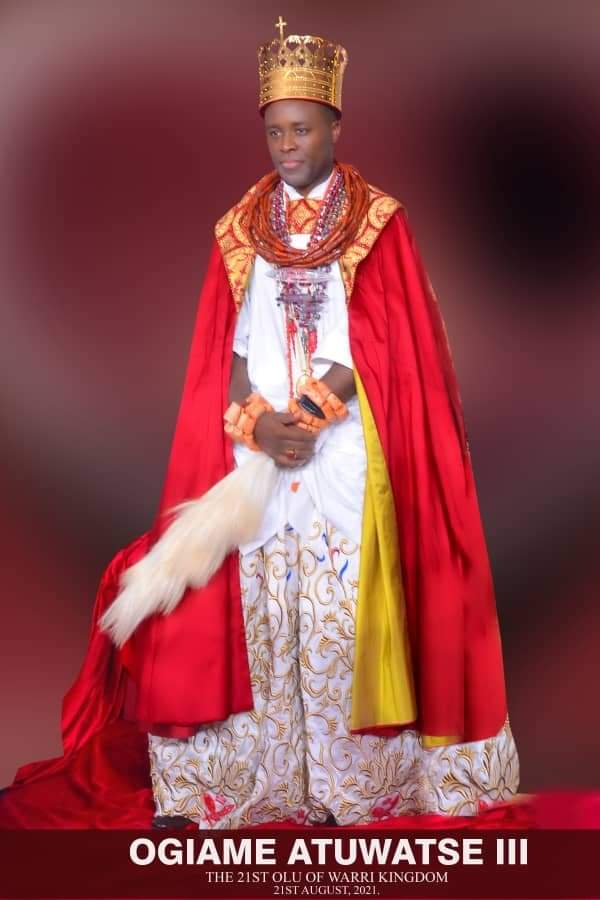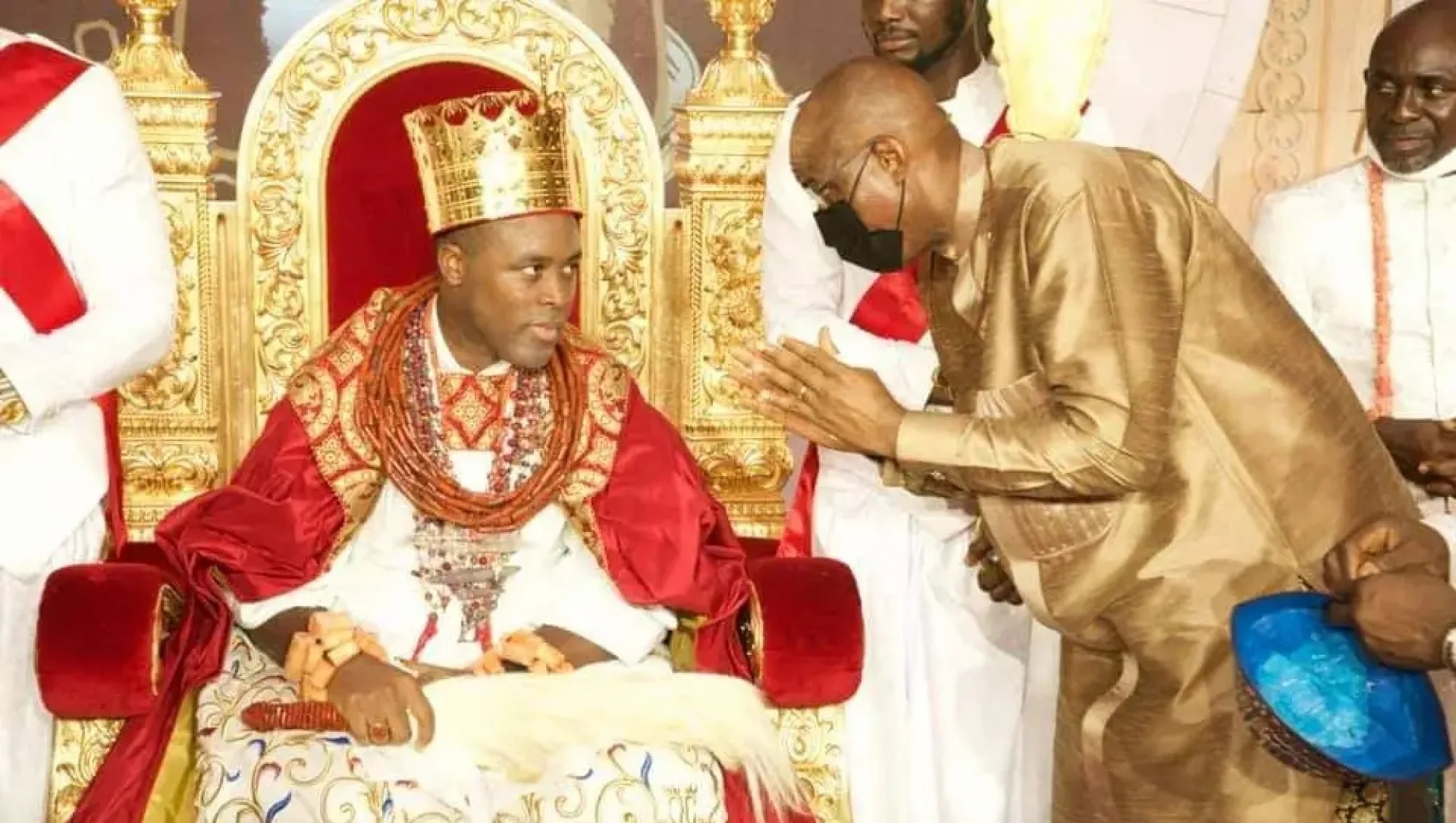
Facts About Okere – The Okumagba (Idimisobo – alias Okere-Urhobo) Connection

When an otherwise ordinary person says that he is a prince, people become curious about his lineage and he must willy-nilly submit to scrutiny. So it is with some rabble rousers among the people of Idimisobo, alias Okere-Urhobo, who have for years been projecting themselves as belonging to a “kingdom” in the traditional homeland of the people of Okere.

Following the communual crisis in the three Warri Local Government Areas in the 1990s, the Okere Community of Warri South Local Government Area of Delta State submitted a “Memorandum to the Judicial Commission of Inquiry Into the Ethnic Conflicts Between Ijaws and Itsekiris in the Warri Local Government Areas”, in May 1997. The Memorandum was signed by Pa Okere Uku (the Acting Olare Aja of Okere at that time) as the primary signatory, and other Okere sons as secondary signatories. The substance of that memorandum is reproduced hereunder for the enlightenment of the general public in the wake of the re-emergence of the ilks of those roughnecks who, disgruntled at the stellar coronation of the 21st Olu of Warri, Ogiame Atuwatse III, that put paid to their false claims of ownership of Warri, are calling for the areas they occupy in Warri Township to be renamed Wado to distingusih them from the people of Warri.

OKERE COMMUNITY

Okere is one of the many communities that make up today’s Warri township. It is also the oldest of these communities. It comprises six (6) quarters known as idimis in Itsekiri, viz.

1. Idimi Odekporo

2. Idimi Jakpa,

3. Idimi Ode-Ile

4. Idimi Ogunobite

5. Idimi Ajamimogha

6. Idimi-Sobo.
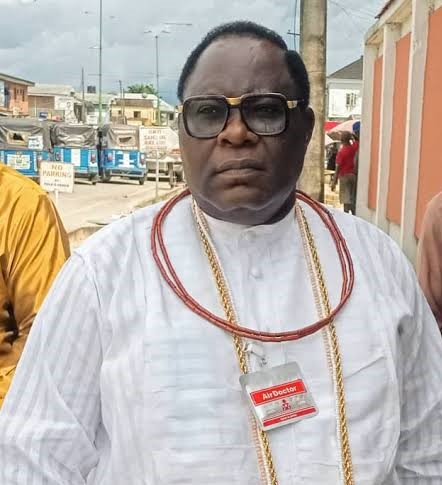
Ogieboro Felix Esisi, Current Olare Aja of Okere

Odekporo is the traditional headquaters of Okere. Of the six quarters listed above, five (5) of them are ancestral homes to the Itsekiri and one (1) is inhabited by the Urhobo. History has it that the Urhobos migrated to Okere some one hundred and fifty years after Ekpen, a Benin war General who was sent by Bini chiefs after Prince Ginuwa and his entourage, had founded Okere and settled there with the remnants of his army and family. The Urhobo immigrants, as they were at that time, were granted leave to settle in Okere by the reigning traditional head of the Okere people, the 4th Olare Aja of Okere, Arunkuneyi, a descendant of Ekpen.

Okere is traditionally headed by the Olare-Aja of Okere otherwise known as Ogieboro. This title is the only recognized traditional title in Okere and was also the only one duly gazetted by the state government unitl the upheavals and politcal intrigues of the 1990s. Only descendants from the male line of Ekpen through Ogitsi (his grandson) are traditionally eligible to occupy the position of Olare-Aja or Ogieboro. Below is a list of the Olare-Aja of Okere from Ekpen to the present time:

1. Ekpen                                

2. Ogitsi

3. Mele                                   

4. Arukuneyi

5. Gbegbenu                       

6. Ejutse

7. Okenrenkporo                      

8. Okoleju

9. Nikoro            

10. Omatsone                    

11. Inomibiaghan

12. Otoku Okerenkporo                       

13. Okutsa Uku

14. Atseboma Okerenkporo

15. Bede Uku

16. Walker Omatsone                   

17. Pa Okere Uku (In Acting Capacity)

18. E. F. Esisi

As already pointed out in passing, Okere was founded by Ekpenede (Ekpen, for short), a general in the Oba of Benin’s army. Ekpen was sent by the Bini chiefs whose sons, numbering about seventy, were on the entourage of Ginuwa 1 when the latter set out from Benin about the middle of the fifteenth century to found his own kingdom at the behest of his father, Oba Olua. While Ginuwa settled at Ijala, and eventually Ode-Itsekiri (Big Warri), Ekpen and his retinue encamped at the place now known as Ogunu in Warri metropolis and later moved further inland to found and settle at Okere about 1497.

R.E. Bradbury, a European historian, in his book “The Benin Kingdom and the Edo-speaking Peoples of South-Western Nigeria” (Pp 180) testifies to the founding of Okere by a part of the Benin army sent after Ginuwa. Also William Moore, in his book “History of the Itsekiris”, affirms that Okere was indeed founded in the last decade of the 15th century by Ekpen. John. W. Hubbard, another European historian, in his book “The Sobo of the Niger Delta” pages 6 to 7, states inter alia… “in the sixteenth century, the Portuguese penetrated up to the Warri River as far as the present site of Warri…, the Jekri (sic “Itsekiri”) living in the village of Okere came to meet the Portuguese”.

ADVENT OF THE URHOBO IN OKERE

The larger part of the Urhobo who occupy Idimi-sobo, alias Okere-Urhobo, came to Okere during the time of Arukuneyi, the fourth Olare-Aja of Okere. One of Arukuneyi’s wives was Idiboye, an Urhobo woman from Okpare in Olomu clan, in present day Ughelli North Local Government Area. Idiboye was the daughter of one Okpeki, an Okpare man, who was also the father of Sowhoruvwe, Owhotemu, Itifo, and Idama who was the youngest. Owhotemu, Itifo and Idama led a band of Okpare people on their way to Ugbokodo, the home town of their mother. They were running away from Okpare due to internecine battles in that community at that time. They passed through Okere on their way to Ugbokodo and stopped by to see their sister, Idiboye. It was Idiboye who appealed to her husband, Arukuneyi, to allow the immigrants to stay in Okere. This was how Owhotemu, Itifo and Idama stayed back and did not continue their flight to Ugbokodo. Other Urhobos from other villages like Okpaka, Ovwian, Effurun, etc. joined them at various times later on. Owhotemu, the eldest of the Okpare immigrants, was given to one lye, an Itsekiri woman and great grandmother of the present day Awani family of Ajamimogha in Okere, as a house help. Itifo and Idama, on the other hand, stayed with their benefactor, Arukuneyi, as house helps also. As helps, they were also assigned to farm duties and as their numbers grew by procreation and further immigration of their kith and kin in Okpare, they were allowed to settle in the farms thus creating the sixth quarter of Okere which was appropriately christened Idimi-Sobo, meaning Urhobo Quarters.

The said Owhotemu is the progenitor of the present day Ighogbadu family, while Idama is the ancestor of the Olodi line and Itifo is the ancestor of the Jarikre line. The ancestor of the Oki family was Ejiyere, son of Sowhoruvwe, who came later on to join the new settlers in Okere. Ejiyere later married an Itsekiri lady, Ukarin, a daughter of the Ogitsi family, and they begat Oki. The late Daniel and Benjamin Okumagba were of the Olodi family.

Below is a list of the descendants of Idama, the youngest of the first three immigrants from Okpare and progenitor of the Olodi family of Idimi-Sobo. This comprehensive lineage, in comparison with the chain of the eighteen Olare-Aja of Okere listed earlier, underscores the fact of a relatively quite recent arrival of the Urhobo in Okere:

1. Idama – the youngest of the three brothers from Okpare that arrived Okere in the later part of the 18th century touted as the first Oroseun of their contrived Okere-Urhobo Kingdom.

2. Olodi –  Idama’s direct son

3. Eboh – Olodi’s direct son

4. Okumagba-Eboh –  Eboh’s direct son

5. Benjamin Okumagba – Okumagba-Eboh’s direct son, born 20th October, 1928 and died in April 2012.

6. Emmanuel Okumagba – the current “Orosuen”

Even if each of them lived to be 100 years old and reigned for that long, obviously the three brothers could not have been in Okere by the time Okere was founded by Ekpen in 1497. In fact, according to R. E. Bradbury in “The Benin Kingdom and the Edo-speaking Peoples of South-Western Nigeria”, even Olomu Clan, of which Okpare, the village from which the three brothers migrated, is a part, was not founded until over a hundred years after the founding of Okere Community by Ekpen.
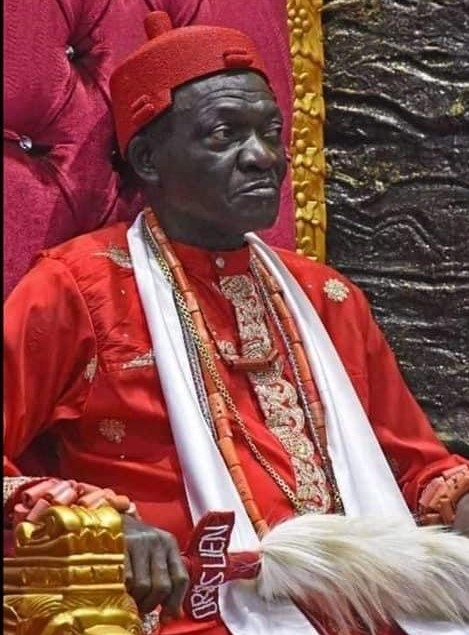
Emmanuel Okumagba, Orosuen of “Okere-Urhobo Kingdom” in Okere Community.

HISTORICAL AND CULTURAL LANDMARKS OF OKERE

There are historical cultural landmarks of the Okere people dating back from the last decade of the 15th century long before the arrival of the Urhobo immigrants. These include:

Ogungbajaokereodola: Like was the custom with early founders of settlements, Ekpen planted his staff at the centre of present day Okere with the invocation “Ogungbajaokereodola” (literally meaning that before war comes to Okere, it will be yesterday – i.e. war will never come to Okere). Ekpen’s staff grew into a tree and this tree has been known by the name “Ogungbajaokereodola” from the inception of the town. It can still be seen by all even today at the Ekpen Street/Okere Market Road Junction just by the Coastline Microfinance Bank.

Arimabo: This is another tree located at the centre of the old Okere Market protected with concrete slabs which constitute the Okere roundabout of today. This tree, planted a few years after the “ogungbajaokeredola” tree, represents a deity which forewarns the community of impending dangers.
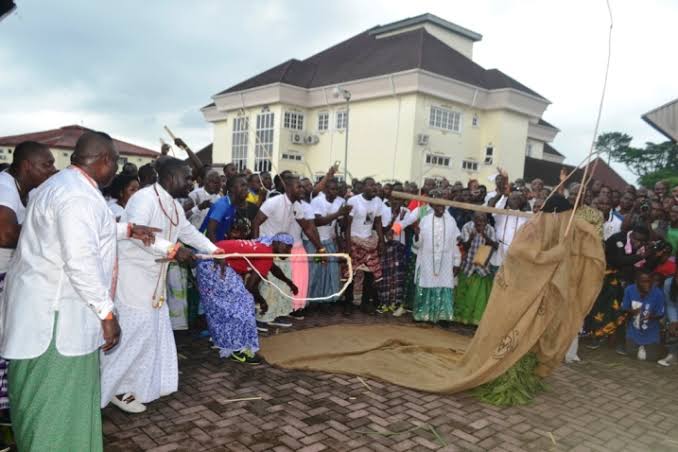
The Itsekiri Awankere (Okere Juju) Festival held annually in Okere for over 500 years to date

Awankere Annual Festival: The Awankere Festival (Okere Juju) is the most popular cultural festival in Warri and environs dating back to the late 15th century. Nobody who has visited and stayed in Warri for a reasonable period can claim ignorance of this festival which has significant similarities with the “Awerewere” festival of the Benin kingdom, the ancestral home of Ekpen, the founder of Okere. Until recently before the breach of the peace in the community, the Urhobo in Okere, along with their kith and kin, partook in this festival annually with their Itsekiri bretheren.

ldimi-Sobo: The name of the quarter where Urhobos stay in Okere is ldimi-Sobo or Uduvwu-urhobo, meaning URHOBO QUARTER in Itsekiri and Urhobo respectively. Existing official documents dating back to colonial and pre-colonial times attest to the fact that this area has always been known as “Urhobo quarters”, as for example in a letter written by Okumagba-Eboh, a descendant of the Idama line of that quarter.

CROSS-CULTURAL TIES

Naturally the Urhobo of ldimi-Sobo in Okere were over the years assimilated into Okere. Their lingua franca was until recently the Itsekiri language. Their dress modes, traditional burial rites, marriage rites and masquerade dances and songs are modelled on those of the Itsekiris and have remained so till date despite faltering attempts at “urhobonizing” themselves so as to be seen as “independent”.
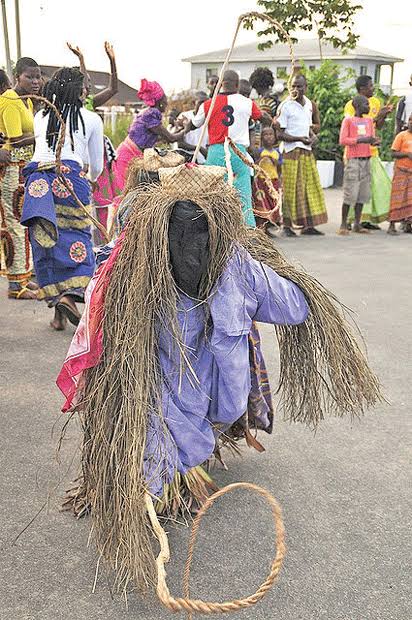
Okere Juju Masquerade in action

Further cultural ties are manifest in the Itsekiri names almost always given to the children of the Urhobo of ldimi-sobo in Okere because for all intents and purposes they used to be more Itsekiri than Urhobo because of extensive intermarriages between them and their Itsekiri benefactors. For example, the late Chief Okumagba-Eboh gave Itsekiri names to almost all his children :-

(i) Henry Uyakominor Okumagba (late) – Uyakominor is an Itsekiri name, meaning “I am fed up with suffering”.

(ii) Chief Daniel Etseoforonetorinmi Okumagba – Etseoforonetorinmi is an Itsekiri name, meaning “It is not the fault of those who laugh at me”.

(iii) Benjamin Oyeoforetseogho Okumagba – Oyeoforetseogho is an Itsekiri name, meaning “wisdom with words is not wealth”.

(iv) Madam Esidami Okumagba (late) – Esidami is an Itsekiri name, meaning “created/protected by God”.

(v) Madam Ejutemiweden Okumagba (late) – Ejutemiweden is an Itsekiri name, meaning “my kind is not rare”.

(vi) Even the name “Okumagba” is not an Urhobo name! It is either a slight corruption of the Itsekiri adage, “Uku e ma agba”, meaning “death does not know/respect age/elders” or a corruption of a common Itsekiri name “Akomagba”.

(vii) Other well known Itsekiri names within Urhobo of Idimi-Sobo in Okere are: Eyitene, Eburu, Emebiren, Oghotemi, Amaofororitse, Eminokanju, etc., etc.

OKERE AND IDIMI SOBO LITIGATION

Unfortunately, what used to be a union of brothers and sisters have for some years now been set more or less asunder by internal strife instigated by largely selfish interests. The Itsekiri of Okere and the Urhobo of Idimi-sobo in Okere co-existed peacefully as one entity until 1927 when Chief Okumagba-Eboh, the fourth in line of the Idama descendants, strayed and attempted to take possession of the land given them by the Itsekiri. This attempt was, however, thwarted by Nikoro, the then Olare Aja of Okere. In suit No. 784/27 held at the then Warri Native Court, Chief Okumagba-Eboh was ordered to pay the sum of five pounds as rent to the Ogitsi family (and therefore to the Itsekiri). An appeal was later lodged by Okumagba-Eboh in the Warri Native Court of Appeal and there setting aside the issue of rent, a new twist was introduced into the case: the question of economic (rubber) trees. The Court President ruled that when the rubber trees were ripe (mature) and sold for money, the Idimi-sobos should pay the sum of five pounds per annum for sacrifice to Ogitsi (a prominent grandson of Ekpen, the founder of Okere). This case was again revisited in 1942 (reference Suit No. W/14A/1942) held at the Magistrate Court of Warri Magisterial Area on 7th January, 1943 before His Lordship William Roland Awunor-Renner. In his judgement, the Magistrate stated inter alia, and we quote, “It is not disputed that the land belongs to the Ogitsi family. There is ample evidence that the defendant/respondent (Okumagba-Eboh for Idimi-sobo) and his ancestors have been on the land for generations. In fact he and his father were born on this land and for him (Okumagba-Eboh) to be removed, it was necessary for the plaintiffs/appellants (Chief Omatsone Tsegbeyeri Awani and Regbeti Popo for Ogitsi-Ekpen family) to prove such grave misconduct, acts and omissions, which would make him (Okumagba-Eboh) liable in law and equity to be dispossessed of the land…”

The other major litigation was suit No. W/48/68 (SC309/74) in respect of the so-called “Okumagba Layout” of recent years. It is noteworthy that in spite of all odds, the Supreme Court did not grant Olodi, Oki and Ighogbadu families of Idimi-sobo radical title to the land in question. Gani Fawehinmi Chambers, acting as counsel to the Olare Aja of Okere and all Okere people, pointed out as follows in an advertised reaction to a July 1, 1992 write-up by Benjamin Okumagba published in the Guardian:

“The judgement of the Supreme Court referred to in the write-up (Idundun & Ors v. Okumagba & Ors [SC 309/74] delivered on 8th October, 1976 and reported in (1976) 1 N.M.L.R. 200, [1976] 10 S. C. 227) did not grant title or ownership of the land in dispute in that case to the respondents therein represented by DANIEL OKUMAGBA & ORS.

“The Supreme Court made it clear in pages 201 and 229 respectively of the above-stated reports where it stated as follows:-  

The averments in the plaintiffs’ amended statement of claim and the evidence adduced in support showed clearly that the claim was based partly on traditional evidence and partly on acts of ownership. The averments in the defendants’ statement of defence and the evidence given by them in support gave a completely different version of the traditional evidence. The defendants also testified as to their acts of ownership on the land in dispute. It must be pointed out at this stage, however, that the defendants did not counterclaim for title to the land.”

He concluded that “… it is trite law and beyond any legal argument that no court has power or jurisdiction to grant to a party a relief he did not claim. In essence, that judgement dismissed the claims as framed which covered only 281.1 acres but did not grant title to the land in dispute to the defendants therein i.e. Daniel Okumagba & Others”.

Obviously, the Olodi, Oki and Ighogbadu families did not ask for radical title to the land because they could not have done so, conscious as they were of the outcome of previous relevant litigations and, more importantly, the fact that it was not their ancestral land. But on the basis of that Supreme Court judgment of 1976 that granted them merely a possessory title to 281.1 acres of land in Idimi-Sobo, they have since then sought to prise themselves from the larger Okere Community, preferring instead to refer to themselves as belonging to an Okere-Urhobo clan which later metamorphosed to “kingdom”. Through political intrigue and maneuvers with a complicit political class in Delta State, they succeeded in the early 2000s in procuring the title of Orosuen and having it gazetted by the State government as their king even when they manifestly have no kingship tradition. Nevertheless, the Okere people remain resolute in their rejection of this scheme and do not recognize any other traditional title in their land than the Olare Aja who is the Ogieboro of all Okere.

OTHER RELEVANT LEGAL CORRELATES

In the case of Ometan versus Dore (Suit No. 25/26), Ometan, an Urhobo man from Agbassa, said under cross-examination that Itsekiri people own Okere. Another Urhobo man, Okandeji, also testified in the said case that Okere is Itsekiri land.

The Deed of Lease over the land presently occupied by the Federal Prisons in Okere was entered into between the people of Okere (Itsekiri) on the one hand and the government of Nigeria on the other hand.

ROOT OF CONFLICT IN OKERE AND WARRI IN GENERAL

Impunity and Disregard for the Rule of Law

The foremost cause of conflicts between the Urhobos in Warri and the Itsekiri is sheer impunity and refusal to obey court judgments and orders.

The Urhobos of Agbassa have refused to accept Supreme Court decision in Ometan versus Dore (supra) cited in Essi versus the Secretary to the Federal Government of Nigeria and Others (supra) which declared them tenants of the Olu of Warri in respect of Agbassa and Igbudu lands. A faction of the Urhobos of Idimi-sobo in Okere, led by Mr. Benjamin Oyeoforetsogho Okumagba, have likewise refused to accept the decision in suit No. W/14A/I942: Omatsone and Others versus Okumagba which declared them tenants of the Okere people. They have also refused to accept the more recent decision of a Warri Court in Suit No. M/51/92 which quashed their claim to an Okere-Urhobo clan and restrained the said Okumagba from parading himself as the Otota of a non-existent clan. This non-acceptance of court decisions has on occasions translated into outright hatred, use of abusive language, and even violence, against the Itsekiri and the institution of the Olu of Warri as was shown in the combined Agbassa and Idimi-sobo attack on the Olu of Warri’s coronation anniversary carnival train in May, 1993.

On the Ijaw side, several court judgements declaring them tenants within the Warri Kingdom (refer to Suits Nos. W/116/56, W/148/56, SC/450/65, W/20/46, W/29/51, WACA No. 3707, W/37/61, SC/393/64, W/30/62, SC/37/1973 and W/143/84) have been publicly described and dismissed by the Ijaw, particularly Messrs. W. Okrika and an otherwise eminent Ijaw leader, E. K. Clark, who ironically is a lawyer, as being fraudulently obtained thus precluding any basis for reasonable or meaningful dialogue. Like the Urhobo of Idimi-Sobo in Okere, they too have had recourse to political maneuvering and intrigue to procure kingship titles for their settlements within the Warri Kingdom in recent years.
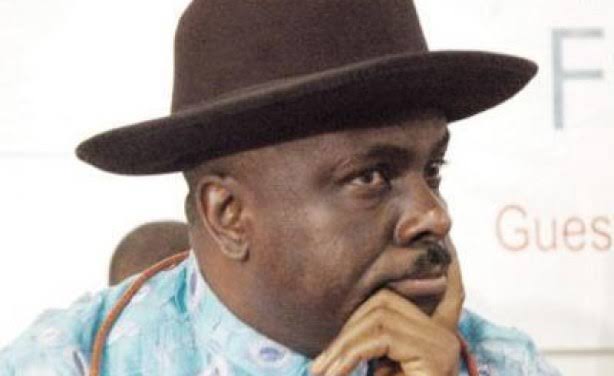
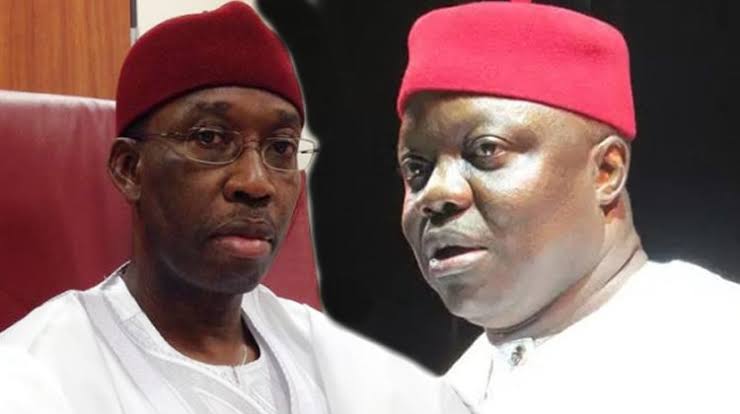
Chief Onanefe Ibori, Dr. Ifeanyi Okowa, and Dr. Emmanuel Uduaghan – Governors of Delta State to date – Triumph of Politics and Nuisance Over Rule of Law?

Pan-Urhobo and Ijaw Movements

The activities of the Urhobo Progressive Union and the Ijaw National Congress, worldwide umbrella organizations for Urhobo and Ijaw interests respectively, have encouraged chauvinism amongst these two ethnic groups in their relationship with their Itsekiri neighbor.

The existence of these umbrella organizations encourages the Urhobo and Ijaw in Warri, who are minorities in the kingdom, to team up with their kith and kin from outside the Warri Kingdom to suppress Itsekiri rights and annexe their lands.

While the Itsekiri have no linguistic or cultural affinity with any ethnic group in Delta State, the Urhobo have and are in league with heir kith and kin from the Urhobo lands of Ughelli, Okpe, Uvwie, and Udu Local Government Areas, as well as with their cousins of the Isoko Local Government Areas. This way, they swell their numbers in Warri kingdom, dominate the State House of Assembly, unduly influence executive political appointments to favor themselves, and so are able to pass resolutions and freely issue gazettes to give legal backing to their every whim.

The Ijaw on the other hand, team up with their brothers in Burutu, Patani, and Bomadi Local Government Areas of Delta State as well as with the entirety of Bayelsa State to also suppress the Itsekiri people in their homeland, invade their communities, forcibly take over their lands and communities, and rename them with impunity. The strife of the 1990’s is a case in point. The Itsekiri were attacked, brutalized and killed in their hundreds in the guise of an ethnic conflict or war whereas indeed it was a deliberate one-sided assault of the Ijaw on defenseless Itsekiri elders, women, and children, with annexation of Itsekiri land and political domination as their singular objective in keeping with their original Kiama Declaration where they claimed that all coastal lands from Akwa Ibom State to Ondo State, regardless of subsisting court judgments, belonged to them. It is thus that despite subsisting 1972 Supreme Court judgments in favor of the Itsekiri with regard to the ownership of Okerenghigho and Bakokodia communities in Warri South-West Local Government Areas, the Ijaw under the presidency of Dr. Goodluck Jonathan (himself an Ijaw man from Bayelsa State), annexed and renamed the communities as Okerenkoko and Kokodiagbene respectively and got the State Government to gazette them as such!

In the ethnic configuration of Delta State, and indeed the entire South-South geopolitical zone therefore, the Itsekiri people, despite their absolute majority in their own homeland comprising the three Warri Local Government Areas, find themselves crowded in, particularly at the legislative and executive arms of government, by two ethnic groups with filial affinity to other Local Government Areas and a neighboring State that actively support and collaborate with them on all fronts. This is a situation that must be addressed urgently.

Conclusion

The Delta State Government, and by extension the Federal Government, has also been a significant spoiler in the quest for peaceful coexistence among the the Itsekiri, Ijaw, and Urhobo in Warri in their inability to uphold and enforce the rule of law. It can even be rightly said that they are complicit in the subversion of the rule of law. How else can one explain the absurdity of creating a kingdom (Okere-Urhobo) out of a community (Okere)?! And the gazetting of a king for such a kingdom by the government in defiance of a subsisting and explicit court judgment (Suit No. M/51/92) that such a kingdom does not exist! It is impunity taken too far. The government, particularly in the aftermath of the Warri crisis of the 90s, rewarded nuisance; the higher the nuisance value, the more substantial the reward. They thus set an unfortunate precedent. It is this precedent that has continued to encourage acts of lawlessness and crass impudence, like the current call for the renaming of parts of Warri Township. The Urhobo and Ijaw in Warri do not have a monopoly of nuisance. Government must live up to its responsibilities to uphold the rule of law and give justice even to the quiescent lest they too be encouraged to deal in nuisance.
Akpos in Crisis of Identity

The entertainment industry is perhaps the one industry where talent is celebrated over and above substance. A silly joke can catapult one to celebrity status overnight with no consideration whatsoever for the cost of the joke. And whilst the audience is reeling with laughter, elsewhere the butt of the joke is seething with resentment. So it is with Akpos and Warri.

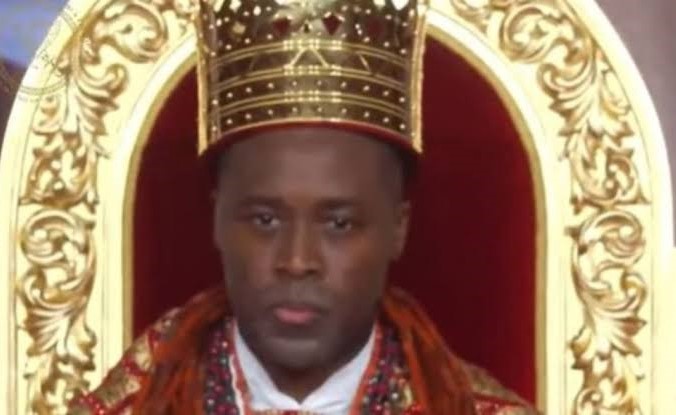
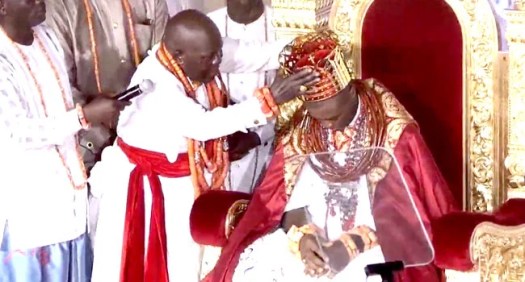
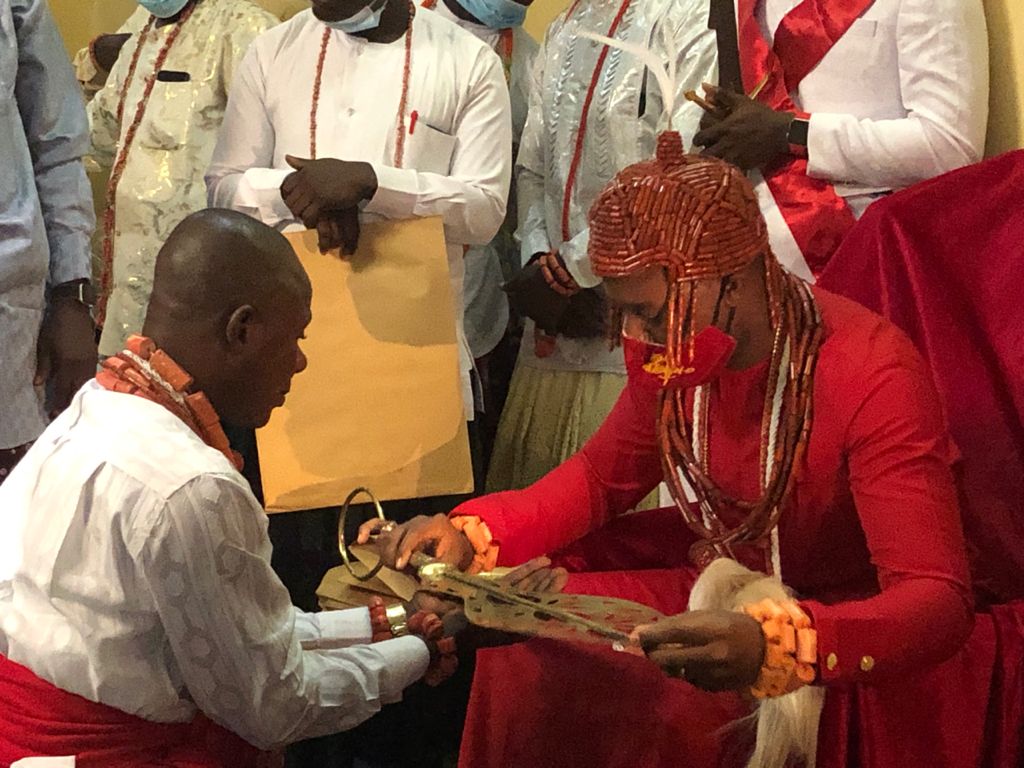
Ogiame Atuwatse III, Olu of Warri, validating one of his chiefs. He holds all the lands in Warri Kingdom in trust for his people.

With the ascendancy of stand-up comedy in these parts of the world, a rash of comics have debuted in this nouveau profession in the garb of “Warri”. From an objective point of view, we must thumbs-up to these debutants for bracing up to the challenge of eking out an honest living for themselves in the face of a dire lack of employment opportunities across the country. From low lifers, some of them have become big names flaunting mansions and big cars and strutting celebrity stages across the land and overseas. Good for them. They are success stories and deserve the accolades – except for the collateral damage they caused in charting their way up. They promoted (and indeed still promote) their initial low life experiencing as Warri, in language and character, and also in representation. It is like picking up a stray boy from under the bridge or thereabouts in Ojuelegba in Lagos and projecting his manner of speaking and character as the model for Lagos! Disservice cannot be better served.

How was it ever possible that this could happen to Warri? No bona fide child, no matter how he loves the game of football, will bring out his mother’s pot to be used as football. Therein lies the answer to the riddle. These Warri comics are not bona fide children of Warri. They are at best naughty children of next-door neighbors and live-in tenants who appropriated Warri and turned it into a football, the butt of rude jokes that have robbed true children of Warri of the dignity and nobility that are traditionally theirs. Check them out – from the one that calls herself “Warri Girl” to the one that has made Akpos a brand. And of course, a few foolish direct children, fascinated by Akpos, join in kicking the pot around, mindless of the ridicule it causes their mother and where their meal comes from.

From rib-cracking one-stanza stage and social media jokes to cartoons and short videos to 30 Days in Atlanta and more recently to 10 Days in Sun City, Akpos has taken on a life of its own and is consistently, even if unwittingly, being projected as the typical Warri person and, by implication of the name, the Urhobo as the typical Warri people – all of which dovetail into the false narrative of Urhobo ownership of Warri.

Such innocuous, and in some instances deliberate, campaign on the sensitive matter of indigene-ship in a plural society as Nigeria is, to say the least, reckless, vexatious, dangerous, and utterly irresponsible, howbeit borne of ignorance. It can be seen, for example, how several Akpos have attempted to rise from oblivion here and there, arrogant, and cocky as only ignoramuses can be, fanning embers of discord on grounds of a faulty understanding of their own badly mangled and incoherent history developed in the last two decades by ethnic bigots and quislings. Peeping from their match boxes of family compounds that they call kingdoms, they are unable to see the vast potential for exemplary brotherly coexistence and unparalleled development that Warri metropolis represents for the entire human race.

At the risk of dignifying what otherwise is genuinely imbecilic, but in order to underscore the nuisance that is the concept of Akpos, below is what a group of them have put on the internet. It is presented unedited to further define the Akpos syndrome by inference.

Following the recent argument between the Itsekiri and Urhobo people of Delta State over who owns the city of warri and the recent crown of their (Itsekiri) King HRM. Utieyinoritsetsola Emiko–Ogiame Atuwatse lll, the Urhobo Sons and daughters have on their part, changed the name of their territories in warri to Wado City.

Passnews learned from some residents in Udu, Agbassa and other area in the city and they all confirmed it’s as a result of ‘who owns the city’ a fight which has been in existence for some years now between the two major ethnic groups.”

Jobless loafers, with half-baked education, lazy, yet haughty and presumptuous, and with professors amongst them that feed them steadily with freshly minted lies about their history, they are complacent and cannot muster the discipline to personally research and discover their roots and so take a humble view of life. They are content with the fallacy that they are all chiefs and no Indians and accept it as gospel truth. So, this write-up is not even for them; they will not have the patience to even scan through. It is for serious-minded readers who may be wary about the facts as to the relative positions of the ethnic groups in Warri metropolis and Warri Kingdom at large. I encourage such readers to please read the papers on “The Story of Warri Township”, “Facts About Okere”, and “Claims of Ownership to Warri” among others in this blog. The facts are verifiable by any level-headed and independent mind even from cursory research dating back to pre-colonial times.

With such a profile, it is no wonder then that the Akpos of this world are today in the dilemma of a crisis of identity. Their Warri garb has been ruthlessly torn off their backs with one sweep of a righteous hand in the aftermath of the momentous occasion of the coronation of the new King of the land, the Olu of Warri, His Royal Majesty, Ogiame Atuwatse III. The global acclaim and recognition, the surrealism of the events, the array of dignitaries drawn by uncanny forces to pay obeisance to the new king, the radiations of his imperial person, and the mystic of genuine kingship so uncommon in this realm yet so gracelessly counterfeited, leave them mesmerized and embarrassed in their nakedness. The reality dawns on them at last that Warri has never been theirs. Worse still, they realize also that they have been making fools of themselves laying claim to the ancestral home of their benefactors.

With vestiges of the usurped Warri cloak still clinging to them, reality forces them to reach for something, anything but Warri, to cover their nakedness. And like shameless thieves that have been caught and surrounded by a mob, their protestations are defiant and desperate as they seek to push the vestiges aside, “I did not touch your Warri o. Okay, take your Warri nah. Me, I am from Wado. I am not from Warri. You can keep your Warri…” 

They have even gone as far as tampering with Google Maps and Waze applications on the internet to show certain locations in Warri as Wado. They forget, or refuse to come to terms with the fact that all the lands they inhabit in Warri are at the instance of the Itsekiri. Okere land belongs to Okere people, not to Idimi Sobo or Okere-Urhobo people, as some of them like to call themselves. The radical title to all of 281.1 acres that is Idimi Sobo, alias Okere-Urhobo, belongs to Okere people. Their Supreme Court victory of the seventies only granted them a possessory title. Likewise, all lands inhabited by the Agbassa Urhobo in Warri, including Agbassa itself, Igbudu, Edjeba, Ukpokiti, Ogunu, and Ekurede-Urhobo, are at the instance of the Olu of Warri. These are long settled legal matters. No sophism or political histrionics can change the facts.

OGIEBORO F. E. ESISI, Olaraja of Okere, Warri

Apart from the radical titles to the Agbassa and Idimi-Sobo, alias Okere-Urhobo, lands, the Itsekiri have the following full-fledged Itsekiri-speaking communities within Warri Metropolis – Odekporo, Ode Ile, Idimi Jakpa, Ogunobite, Ajamimogha (all in Okere), the entire GRA and Nigerian Ports Authority lands, Alders’ Town, Pessu Town, Odion, Merogun, Ugbori, Ekurede, Ugbuwangwe, Ubeji, Egbokodo, and Ifiekporo. Thus it is that the Itsekiri own the entirety of Warri metropolis. Itsekiri will not give up an inch of their ancestral lands no matter the amount of intimidation. The rascality of recent governments exhibited in unilaterally creating kingdoms out of family compounds and gazetting kings for them, cannot stand the test of time and natural justice.

At no time were the Urhobo of Idimi Sobo and Agbassa ever asked to leave Warri. The Itsekiri have always been hospitable to them despite failed attempts by the Urhobo to wrest the lands from the Itsekiri by brute force or force of litigation. They, the Urhobo in Warri, always had, and still have, the choice to live harmoniously with their Itsekiri benefactors but have instead chosen to be prodigal in their conduct over the years. Hence their crisis of identity today, being neither here nor there. Many of them bear Itsekiri names even as they chant their “wadoness”. They would have an Okumagba Layout in their Wado City. Ask them what the meaning of Okumagba is in Wado or Urhobo, they would not know because Okumagba is an Itsekiri word. None of this shenanigan makes any sense. Things like this only happen when people are blind. Blind with envy and driven in their blindness by greed and covetousness. Check out the family tree of the principal actors and you will find that they mostly have Itsekiri mothers, grandmothers, or grandfathers, and at worst Itsekiri in-laws.

Perhaps the one thing that could curb the bloated ego and restore some sense of self-respect to the Akpos of this world is to look them straight in the eyes and ask them to take the counsel of one Billy Oghenebrume in a post titled “LET PEACE REIGN IN RESPECT TO THE TITLE OLU OF WARRI” which trended on social media in the last month –

“The Itsekiri people do not have problem with Urhobo-speaking people. Having issues of title to lands with Okumagba family and Agbassa people who are Urhobos does not amount to Itsekiri people having ethnic war with Urhobo-speaking people. Itsekiris are peace-loving people and will continue to be peace loving.

I particularly don’t see any of my friends in Warri along ethnic lines because we share almost everything in common but Warri as a city and as a name has its own history from pre-colonial, to inter-colonial, and post-colonial eras, and by virtue of Supreme Court judgements to lands which ethnic sentiments can no longer change.

In post- and inter-colonial times, Warri served as the base for Portuguese, Dutch and British slave traders hence the early western education enjoyed by Itsekiri people. Warri was ruled by Itsekiri elites and the last GOVERNOR OF WARRI was the person of Chief Dore Numa. Warri was made PROVINCIAL headquarters (WARRI PROVINCE) by the British in the early 20th century.

Because WARRI PROVINCE then covered the whole of present-day Delta State (excluding Anioma areas), the OLU OF WARRI TITLE gave rise to protests from various ethnic groups within the province in 1950 through 1951 that the Olu of Warri title should be changed to Olu of Itsekiri and this was temporarily granted by the government for peace to reign.

But Warri is a name of a place to a people, aside being the capital of the then Warri province. There is nowhere like no man’s land, everywhere is attached to a people. The Itsekiri people responded by virtue of history that while they don’t own the entire WARRI PROVINCE (as then defined) they own Warri as a place (kingdom), as a town, and as a people, and as such it should reflect in the title of their King.

After the coronation of Ginuwa II, Itsekiri people petitioned Lagos and London, making a case for their Olu’s title. This matter became an issue of topical importance, and no less a person than Dr. Nnamdi Azikwe contributed to the debate then in the West African Pilot of 14 May 1940 as follows:

“His highness Ginuwa II is Olu of the Itsekiri-speaking people who live in Warri Township. If the matter is to be discussed in detail, it will be found that a definite title is necessary, in which case the Olu of Warri seems to be most historical and correct. When we speak of the Oba of Lagos, we refer to the paramount Native Ruler of Lagos Township, although Lagos is populated mainly by Yoruba-speaking peoples and Lagos is part of Yoruba land. So too in the case of his Highness Ginuwa II, the Olu of Warri, the paramount Native Ruler of Itsekiri-speaking people and Warri town is Itsekiri Land”.

That was vintage Dr. Azikiwe, a patriot and nationalist who also joined the debate on the OLU OF WARRI TITLE in those days. Then, when independence drew near, Awolowo, the government leader in the Western Region, well known for never toeing Dr. Azikiwe’s political lines, had to take the matter of the Olu of Warri title to Parliament in 1952. After a healthy debate there, the Delta parliamentarians accepted that WARRI PROVINCE be changed to DELTA PROVINCE so that Warri, as a name, and a place should revert to those who own it.

On the prompting by London, the Governor General in Lagos, following the parliamentary approval of the title “THE OLU OF WARRI” In Ibadan in May 1952, wrote a report to London dated 14 Oct 1952 justifying the change, saying it was based on “sound historical grounds especially as Warri Division (sic. Jekri-sobo Division) which consisted of two areas, the Itsekiri and the Sobo area” had been separated” (C544/708/of Colonial records).

This change, acclaimed as a victory by all parties (including Urhobos) involved, removed the universal impression that all ethnic groups in the province would be regarded as subjects of the Olu of Warri because of the former name ” WARRI PROVINCE”. The non-Itsekiri Parliamentarians were all satisfied with the change, Hon… Otutu, a Kwale parliamentarian on their behalf, proclaimed in the Daily Times of 31 January 1953: “we accept the change.” On the Itsekiri side, rightful title of their Olu had reverted to the ancient throne.

“In recent times, those protesting against the title of the Olu of Warri are ignorant of what their forebears had accepted and adopted approximately 60 years ago in good faith.

I repeat, the Olu of Warri title has grown in history and legacy above ethnic lines. Warri is for everyone to stay but the title, the Olu of Warri, cannot be changed in history.

THE CREATION OF NEW AND RIVAL KINGDOMS IN NIGERIA IS NOT PART OF THE CHARACTER OF ITSEKIRI PEOPLE.

Now, the reading public may be able to assess from the following verifiable facts the reasonableness and peace-loving nature of the Itsekiri in Delta State: –

The “Okumagba family” merely won a possessory title (see radical title) to a 281.1-acre farmland near Okere part of Warri by a court judgment and has sought to have a rival kingdom in Warri called “Okere Urhobo kingdom”.

Now look, “the Mene-Okotie family” of “Itsekiri extraction” has by a judgment in suit no. S/66/69 of the same Supreme Court won a 775.10-acre family land within the Urhobo kingdom of Mosagar. To the relief and joy of the entire Mosagar Community, the Mene-Okotie family has shunned setting up a kingdom there.

Also Gbolokposo, another Itsekiri Community, by another Supreme Court judgment, No. Sc/98/1993, has won and radically owns 1993.77 acres of their land under the overlordship of the Olu of Warri within the Uvwie kingdom in Urhobo land. Today they are living happily together and the Gbolokposo Itsekiri are not thinking of setting up any kingdom in Uvwie land.

If we go by ownership of land, whether possessory (given to settlers and customary tenants who have settled for a long time) or radical title given to Aboriginals, by the equation, 1993.77 ÷ 281, 775.10 ÷ 281.1, this will give the Itsekiri people 7 kingdoms in Uvwie (URHOBO LGA) and approximately 3 Itsekiri kingdoms in Mosagar (IN URHOBO LGA). Should Itsekiri therefore start saying that there should not be an Ovie of Uvwie or there should not be Ovie of Mosagar? Should Itsekiri people start proliferating kingdoms in those places where they have radical titles to land? I guess many Urhobos will frown. As much as people can choose to do what they like, we cannot afford to be having kingdoms on every piece of land.

You can read the Supreme Court Judgement on Igbudu (Agbassa) lands here: https://lawcarenigeria.com/chief-sam-warri-esi-vs-the-chief-secretary-to-the-federation-of-nigeria-ors/

Bless you, Oghenebrume! With the likes of you, peace and harmony shall certainly reign in these lands of our forefathers and those who for selfish reasons do not want peace shall be rolled over in the inevitable change! But lastly, a word for our comedians. Stop playing football with our mother’s pot. Akpos is not a “Warri boy”; at best he is an Agbassa or Idimi Sobo alias Okere-Urhobo boy. Address your Akpos as such in your shows and please spare our town and kingdom the ignominy of representation in that character. And, by the way, Warri is not “area!”. We are people of a noble deportment.

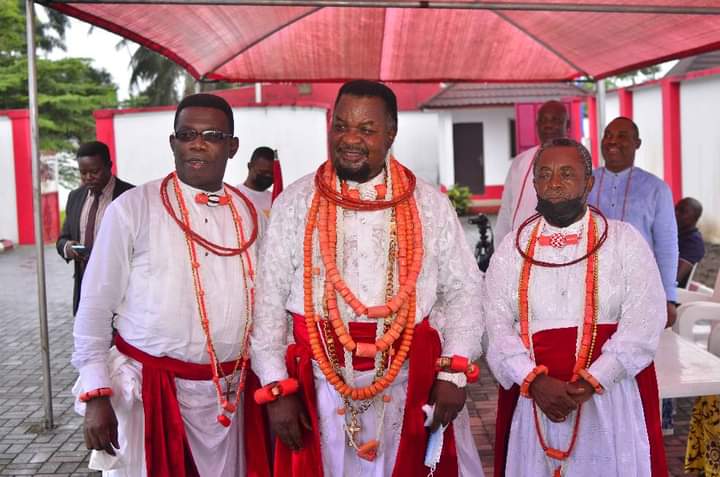
The Iyatsere of Warri Kingdom, Chief Atserunleghe, flanked by two of his co-chiefs. Poised to reposition the Warri Kingdom for peace, progress and development.

NDDC and Warri

Ogiame Atuwatse III, Olu of Warri. Eager for development of Warri Kingdom.

On the Home Page of its website, nddc.gov.ng, its Mission Statement screams at the wary visitor: –

To offer a lasting solution to the socio-economic difficulties of the Niger Delta Region and to facilitate the rapid and sustainable development of the Niger Delta into a region that is economically prosperous, socially stable, ecologically regenerative and politically peaceful.

And for the singular reason of this much touted mission statement, every visitor to the offices or website of the Niger Delta Development Commission, must involuntarily be wary. Set up by the Obasanjo-led PDP administration under the instrument of the Niger Delta Development Commission (Establishment, etc.) Act of the 12th day of July 2020, the Commission has by all accounts, and to all intents and purposes, failed to fulfill the objectives for which it was set up.

According to Section 7 of the NDDC Act, the Functions and Powers of the Commission include

 (1)  The Commission shall-Formulate policies and guidelines for the development of the Niger Delta area

(a) Conceive, plan and implement, in accordance with set rules and regulations, projects and programs for the sustainable development of tie Niger-Delta area in the field of transportation including roads, jetties and waterways, health, education, employment, industrialization, agriculture and fisheries, housing and urban development, water supply, electricity and telecommunications.

(b) Cause the Niger-Delta area to be surveyed in order to ascertain measures which are necessary to promote its physical and socio- economic development,

(c) Prepare master plans and schemes designed to promote the physical development of the Niger-Delta area and the estimates of the costs of implementing such master plans and schemes.

(d) Implement all the measures approved for the development of the Niger- Delta area by the Federal Government and the member States of the Commission.

(e) Identify factors inhibiting the development of the Niger-Delta area and assist the member States in the formulation and implementation of policies to ensure sound and efficient management of the resources of the Niger-Delta area.

(f) Assess and report on any project being funded or carried out in the Niger-Delta area by oil and gas producing companies and any other company including non-governmental organizations and ensure that funds released for such projects are properly utilized.

(g) Tackle ecological and environmental problems that arise from the exploration of oil mineral in the Niger-Delta area and advise the Federal Government and the member States on the prevention and control of oil spillages, gas flaring, and environmental pollution.

(h) Liaise with the various oil mineral and gas prospecting and producing companies on all matters of pollution prevention and control.

(i) Execute such other works and perform such other functions which in the opinion of the Commission, are required for the sustainable development of the Niger-Delta area and its peoples.

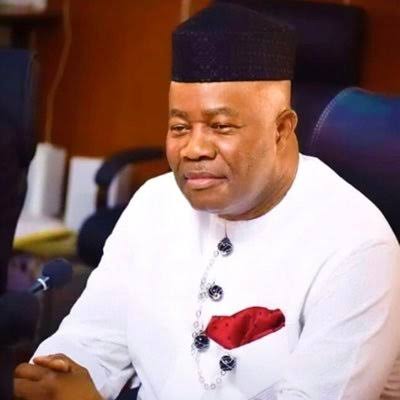
Senator Godswill Akpabio, Minister of Niger Delta Affairs

Business objectives, let alone government objectives, like the ones set out in Niger Delta Development Commission Act, can not be any clearer or action-oriented. These are weighty, nevertheless measurable and achievable statutory functions of the Commission ought to have transformed the entire Niger Delta into a Dubai of sorts in Nigeria within the first decade of the existence of the commission if those who run it ever give heed to their avowed Mission Statement.

And it was not for lack of funds that the commission failed. Far from it! It was lavishly funded. Section 14 of the Act provides that -The Commission shall establish and maintain a fund from which shall be defrayed all expenditure incurred by the Commission.

(1) There shall be paid and credited to the fund established pursuant to subsection (1) of this section –

(2) From the Federal Government, the equivalent of 15 percent of the total monthly statutory allocations due to member States of the Commission from the Federation Account; this being the contribution of the Federal Government to the Commission-

(3) 3 percent of the total annual budget of any oil producing company operating, on shore and off shore, in the Niger-Delta Area; including gas processing companies.

(4) 50 percent of monies due to member States of the Commission from the Ecological Fund,

(5) Such monies as may from time to time, be granted or lent to or deposited with the Commission by the Federal or a State Government, any other body or institution whether local or foreign.

(6) All monies raised for the purposes of the Commission by way of gifts, loan, grants-in-aid, testamentary disposition or otherwise; and

(7) Proceeds from all other assets that may, from time to time, accrue to the Commission.

The Niger Delta Development Commission was thus a statutorily well fed cash cow. And practically too. But its milk did not reach the people it was set up to nourish. According to the Minister of Justice and Attorney General of the Federation, Abubakar Malami, when he was receiving the report of the recently concluded forensic audit of the commission, a humongous sum of some 6,000,000,000,000 Naira (Six Trillion Naira) comprising of N3, 375, 735,776,794.93 (Three Trillion, Three Hundred  and Seventy Five Billion, Seven Hundred and Seventy Six Thousand, Seven Hundred and Ninety Four Naira, Ninety Three Kobo) as budgetary allocation and N2,420,948,894,191.00 (Two Trillion, Four Hundred and Twenty Billion, Nine Hundred and Forty Million, and Eight Hundred and Ninety Four Thousand, One Hundred and Ninety One Naira) as income from statutory and non-statutory sources, accrued to the commission between the years 2001 and 2019.

What did the Commission do with all that money? Where are the development projects and infrastructure it was established to build? On every function of the commission listed in the Act that established it, it failed glaringly and woefully. It could not even complete its own secretariat that it started as OMPADEC as far back as 1996 until the focused intervention of the present government compelled it to do so only this year, 25 years after!

The NDDC failure is even more dismal in Warri and environs. In flagrant disregard of sub-section 2 of Section 7 of the Act, viz. “In excising its functions and powers under this section, the Commission shall have regard to the varied and specific contributions of each member State of the Commission”, the commission relegated the entire Warri Kingdom, which contributes over 28% of the country’s revenue from Oil and Gas to the status of a mere onlooker.

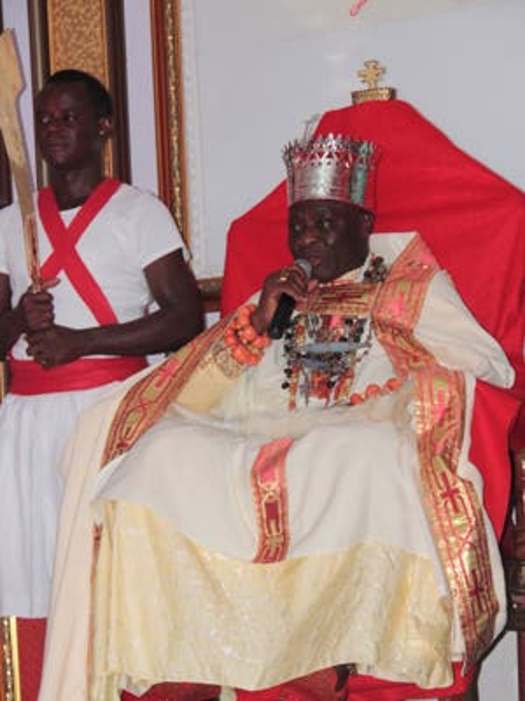
Ogiame Ikenwoli, immediate past Olu of Warri, lamented NDDC projects in the Kingdom

As part of activities marking the 5th year anniversary of his coronation, the immediate past Olu of Warri, His Majesty Ogiame Ikenwoli, on the 10th day of September 2020, undertook a tour of NDDC and Federal Government projects in the Kingdom. It was lamentation all the way.

(1) At Koko in Warri North Local Government Area, His Majesty urged President Muhammadu Buhari to revoke the contract for the shoreline protection project in the town awarded by the Niger Delta Development Commission (NDDC). He expressed grave displeasure over the shoddy job by the contractor and which had even been abandoned, thus allowing the ocean surge to wipe out parts of the historic town of Koko. Putting it very bluntly and candidly, he said that the project was not only shoddily done but had also been abandoned by the firm handling it on behalf of the commission. “We thank (President) Buhari for the shoreline protection project, but my people are not happy with the job done so far and we are rejecting it,” the monarch concluded pointedly.

(2) The Koko-Oghoye Road, also in Warri North Local Government Area, which will traverse Delta, Ondo, and Lagos States on completion, was conceptualized in 1955 through the instrumentality of late Chief Festus Okotie-Eboh who was then the Federal Commissioner of Finance. The project was awarded to Levant Construction Limited in 2010 by the Niger Delta Development Commission (NDDC), 10 full years ago and it is nowhere near completion. The monarch had to literally beg for what rightfully belongs to his people: “We appeal to the Niger Delta Development Commission, NDDC, and the Honorable Minister of Niger Delta Affairs to complete this road and open the Benin River corridor all the way to Lagos by road.”

(3) The $16bn Gas Revolution Industrial Park and EPZ Project in Ogidigben in Warri South-West Local Government Area is another project the immediate past Olu of Warri had to beg for despite its immense benefit to the nation at large in terms of gas utilization and savings from gas flaring. “When the ground breaking ceremony was done in January 2015, our hopes were very high for the nation at large. Since then, however, not much has been done”, the monarch lamented.

(4) Sometime in 2016, the NDDC invited tenders for some 375 projects in the Niger Delta. 61 of these projects were allocated to Delta State. Of these 61 projects, however, not a single project was allocated to the Warri Kingdom which accounts for over 80% of the Oil and Gas revenue accruing to the State. Miffed at this utter disregard and show of disdain, the then member representing Warri Federal Constituency in the House of Representatives, Honorable Daniel Reyenieju, took to his Facebook Page to rally his people: “Indicate your readiness to march on NDDC!!!”, he wrote in desperate rage.

President Mohammadu Buhari – Ordered forensic audit of NDDC from 2000 to 2019

With such glaring neglect and dereliction of responsibility by the Niger Delta Development Commission, it was therefore not surprising that perplexed by the glorious possibilities that the humongous investment in the commission ought to have achieved but which it did not achieve, President Mohammadu Buhari had to order a forensic audit of the accounts of the commission from inception up to 2019 when the order was given. And no sooner was the order given than all sorts of maneuvers, political and otherwise, began to play out solely with the ulterior motive of scuttling the audit.

The most intriguing of these maneuvers played out on the stage of the amphitheater that is our National Assembly. The gates opened at about 12 noon on Monday, 20th day of July 2020. On the cast were the Acting Managing Director of the Commission, Prof Kemebradikumo Pondei; the Minister of Niger Delta Affairs, Senator Godswill Akpabio; and members of the House Committee investigating alleged financial rascalility in the Niger Delta Commission. The committee was chaired on this auspicious day by none other than the current representative of Warri Federal Constituency, our own Honorable Thomas Ereyitomi, the only representative that the Warri people, who contribute over 28% of the nation’s oil and gas revenue, have in the entire National Assembly.

Watching expectantly from the sidelines, one could not but relish in advance the prospect of a dramatic irony playing out in the confrontation between the NDDC and the House Investigative Committee. For here was a commission before an investigative committee presided over by the representative of a people whom it has consistently excluded from membership of its Board and Management Committees and also cruelly marginalized in the allocation of development projects in the two decades of its existence despite the fact that this people contribute about a third of the funds that sustain it. There was going to be some lashing here, no doubt.

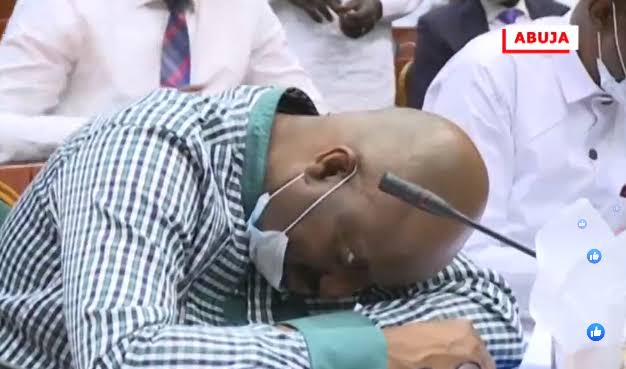
So, enter Professor Kemebradikumo Pondei, Acting Managing Director of the Niger Delta Development Commission flanked by members of his team. Making what he must have considered a professorial dissertation, the professor said that N34bn was given to the commission  by the Federal Government between January and May 31, 2020 and that between the 20th February and the 31st May 2020, his Management Committee had only spent a paltry N59.1bn out the N81.5bn spent by the commission from the 31st October 2019 to the 31st May 2020. Out of this N51.9bn, he continued, N38.6bn was spent on capital projects which contracts were awarded prior to his assumption of office. Another N20.5bn was spent on recurrent expenditure during the same period. And, yes, they also spent N1.32bn on COVID-19 palliative, not N1.5bn, he insists, adding that he did not know the budget from which the palliative expense was taken! …

Billion… Billion… Billion… Heads swooned, and the professor’s head must have swooned too, for as the probing continued and he battled to maintain his balance on his seat, he fainted! And that was it. And then the fainted professor, on his very own feet, walked out of the venue and never returned. And a brutalized Warri Federal Constituency, starved of projects and development for 20 years, was presiding!

Professor Kemebradikumo Pondei, Acting Managing Director of NDDC, in a faint at House of Representatives public hearing

An hour later, it was the turn of the Honorable Minister of Niger Delta Affairs, Senator Godswill Akpabio. It did not take much time before the Honorable Minister pointedly accused members of the National Assembly of being the principal beneficiaries of contracts awarded by the commission. An agitated member of the investigative committee, Honorable Goodhead Boma, challenged the minister to name the beneficiaries among the lawmakers and the Minister retorted: “Are you asking me who the beneficiaries are in the National Assembly? I just told you that we have records to show that most of the contracts in the NDDC are given to members of the National Assembly… It is you people now! Because if you look at your chairman…”

For whatever reason, Warri Federal Constituency, despite having been starved of projects and development by the commission for two decades, sought to stop the minister from continuing with his deafening revelations; but Hon Boma Goodhead, obviously representing a better fed constituency, was in the spirit and heatedly demanded to know what the benefits to members of the National Assembly from the NDDC are. The Minister, equally in the spirit, replied glibly: “That is why we have to change the modus operandi. You must not allow the two chairmen to hijack the budget every year. You are like me. I was a member like you. I did not know what was going on…”

Hon. Thomas Ereyitomi, Member representing Warri Federal Constituency at the National Assembly – Asked ND minister to “off the mic” at House of Representatives public hearing.

Even in retrospect, one is still at a loss what pushed Warri Federal Constituency to it. With several bangs of the gavel, he began to protest: “Honourable minister, that’s okay, It’s okay..it’s okay!” He kept pleading desperately, like a wife who does not want her abusive husband exposed to public opprobrium, even as the minister and Honorable Goodhead engaged in heated debate… “Honourable member.. Honourable minister, it’s okay. That is okay… it’s okay… Honourable minister… Off your mic. Off the mic…” Warri Federal constituency, a constituency relegated, repressed, and treated with contempt in the affairs of the Commission, playing the obscurantist just when we had a minister who was ready to throw open the can of worms that is the NDDC for the world to see how we had been grossly shortchanged! When the drumbeats and the dance steps are not in tandem with the mood of the people, then for whom is the dancer dancing?

Anyhow, not unexpectedly, nothing came out of the much-publicized House of Representatives investigations into the financial rascality of the NDDC. But a determined presidency kept the forensic audit on track through the minister. So it was that on the 2nd day of September 2021 the report of the audit was received by the Honorable Minister for Justice and Attorney General of the Federation, Abubakar Malami, on behalf of the President and Commander in Chief of the Armed Forces of Nigeria, Mohammadu Buhari.

Receiving the report, the Minister of Justice noted that the call for the audit by the people of the Niger Delta Region arose from the huge gaps between resources invested in the region vis-à-vis the huge gap in infrastructural, human, and economic development in the region. He made the following succinct points: –

  • It is on record that between 2001 and 2019, the Federal Government has approved, which brings the total figure to the sum of approximately Six Trillion Naira given to the Niger Delta Development Commission.
  • Consequently, the Federal Executive Council (FEC) approved the engagement of a Lead Forensic Auditor, as well as 16 reputable Audit Firms to conduct the audit exercise.
  • The President is delighted that the auditors have now completed this exercise and the Report is today being presented.
  • Furthermore, the President is not oblivious of the interest generated by Stakeholders towards the forensic audit exercise and the agitation for the constitution of the Board of the NDDC. However, this Administration is determined to address challenges militating against the delivery of the mandate of the NDDC to the people of the Niger Delta Region.
  • It is in the broader context of the foregoing developments that the President recently signed into Law the Petroleum Industry Act (PIA) which has been a contentious issue over the years for successive Governments, to bring about the prudence and accountability in the Petroleum Sector and to give a sense of participation and ownership to the Host communities.
  • The Report on the forensic audit of the NNDC and recommendations will therefore be critically analysed for necessary action and implementation. We owe it a duty to the people of the Niger Delta Region to improve their standard of living through the provision of adequate infrastructural and socio-economic development.
  • The welfare and socio- economic inclusion of the Niger Delta Region is paramount to the development and security of the Region and by extension the Country. Funds spent on development activities should as a consequence promote political and socio-economic stability in the Region. Citizens affected by these development projects should also exhibit the ability to contribute to the continuous progress of their immediate and wider communities by engaging in constructive activities that will sustain and supports these development projects.
  • It is evident that considerable resources have been channeled by the Federal Government to the development of the Niger Delta from 2001 to 2019. It is therefore important for the Federal Government and the public to be properly informed of what has been spent and how that has been spent. The essence of the forensic audit is to ensure probity and accountability in the use of public funds. It is against this background that the Federal Government will without hesitation strategically implement all aspects of the audit exercise that will promote probity and greater prosperity for the Niger Delta Region and Nigeria as whole.
  • The Federal Government is particularly concerned with the colossal loss occasioned by uncompleted and unverified development projects in the Niger Delta Region, in spite of the huge resources made available to uplift the living standard of the citizens. We have on record over 13,777 projects, the execution of which is substantially compromised.  The Federal Government is also concerned with the multitudes of Niger Delta Development Commission’s bank accounts amounting to 362 and lack of proper reconciliation of accounts.
  • The Federal Government will in consequence apply the law to remedy the deficiencies outlined in the audit report as appropriate. This will include but not limited to initiation of criminal investigations, prosecution, recovery of funds not properly utilized for the public purposes for which they were meant for  review of the laws to reposition and restructure the NDDC for the efficiency of better service delivery amongst others. In all these instances of actions, legal due processes will strictly be complied with.
  • The President has directed that the forensic audit report be forwarded to the Federal Ministry of Justice for a legal review and relevant Ministries, Departments, and Agencies of Government will be engaged in doing justice to the findings accordingly. 
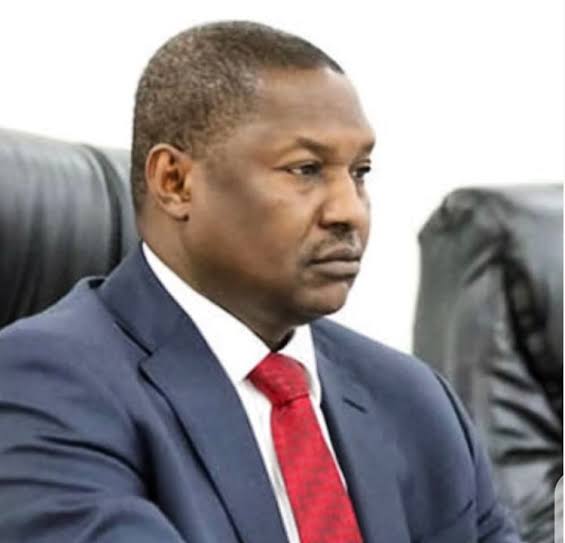
Abubakar Malami (SAN), Attorney General and Minister of Justice – Received forensic audit report

As is to be expected, some shadowy groups are already casting aspersions on the modus operandi and findings of the forensic audit exercise. One group, Niger Delta Justice Forum, in a September 7 open letter to the Minister of Justice, even contests the Six Trillion Naira that reportedly accrued to the NDDC over the period covered by the audit and claims instead that it was 2.4 trillion Naira only. They add also that many of the projects were not accessible to the audit team because they are hidden in interior creeks, etc. Short of an attempt to throw spanners in the works, what does it really matter whether it is 6 or 2.4 trillion in a context that amounts to outright brigandage? What is of concern to the people is what was done with whatever money was made available for developmental projects in the region. Where are the projects? If they exist, surely nobody need to worry about whatever the audit report says. All that anybody wrongly accused needs to do is to show commensurate value for money received. It is understandable that big, fat rats that have been smoked out by the audit will be embarrassed that the public will marvel at their size and species and as such they will try to pull a trick or two to save face as they scurry for cover. Let those of us commoners be mindful therefore of jumping to their defense on the basis of ethnic and other primordial sentiments lest we become double losers. Let us also be mindful not to be counted amongst the rash of usually outspoken Niger Delta radicals and activists from youths to nonagenarians whose loud silence now must distinguish them from the rest of us on whom they have feasted recklessly all these years. Let it not be said, as one trending social media post put it, that this one is “looting of the Niger Delta people, for the Niger Delta people, and by the Niger Delta people”. No, this one is looting by mindless criminals who all these years have represented themselves as fighting for our interests whilst all the while deepening and lining their pockets with our inheritance. It is a matter of the backwardness they have foisted on the region because of their selfishness, the hardship our people have had to suffer because of their insatiable appetite and mindless greed.

Meanwhile, a civil society organisation, the Media Initiative Against Injustice, Violence and Corruption, has invoked the Freedom of Information Act and asked the Attorney-General of and Minister of Justice to make the forensic audit report public. This is a welcome development. People of the Niger Delta need to know who their true enemies have been all these years.

Warri Kingdom Goes Agog…

THE CROWNING MOMENT!!!

Expectation is the stuff of which great events are made. The uncertainties, the yearning, the praying, the striving, the preparations, and then finally, the orgasmic experience of release followed by that afterglow that only a truly sated one can emanate.

Thus it was from 21st December 2020 when rumor started making the rounds that Ogiame Ikenwoli, the Olu of Warri since 2015, had joined his ancestors. The palace promptly refuted such abomination and issued a statement to the contrary, positing instead that the monarch was merely indisposed. But the rumor was stubborn, would not go away, and waxed stronger as the attention of the palace moved from refuting it to managing emerging burning issues within its walls. Then finally, like an over pressured water hose, snippets of the truth of the matter began to ooze forth from overwrought segments.

First were some spurts from the Igba of Warri, Chief Rita Lori-Ogbebor, who through a series of notifications via “The Voice of the Itsekiri Women”, raised several issues obliquely referencing the demise of Ogiame Ikenwoli and then directly confronting the monarch’s handlers for the manner of his transition. In a comprehensive report by Shola O’Neil published in The Nation of 22nd March 2021, the foremost female chief of the kingdom is reported to have in a petition through her Abuja-based lawyers also questioned the monarch’s handling by some persons. According to the report, she accused a trio of the late monarch’s closest confidants and family members of irresponsibility –

“Sequel to the widely circulating news … over the demise of His Royal Majesty, Ogiame Ikenwoli, on or about 20th day of December, our client (Chief Lori-Ogbebor) was mandated to immediately travel from Lagos to Warri as is mandatory for a chief of the palace,” the petition stated. The document alleged that the monarch was exposed to “situations and circumstances that were flagrantly in violation of COVID-19 protocols, allowed to attend prolonged social gatherings and meet with visitors some of whom were later found to be infected with the virus and also died.”

With this, there was hardly any anymore doubt in the land that the 20th monarch of the Warri Kingdom had joined his ancestors. But the then Ologbotsere, Chief Ayiri Emami, would have none of it. According to The Nation’s report, he had retorted when asked: “Have I told you that the monarch has passed on? So, why are you asking about the palace? Have you been invited to an Alejefun (traditional rite where the death of the monarch is announced in Ode-Itsekiri)?”

So, the nation had to wait with bated breath for some official pronouncement to dispel the rumor or clarify the matter. But the hose literally burst as concern shifted from the rumored demise of the monarch to who the successor to the ancient throne of the kingdom will be. In this, a major spurt again came through the indefatigable Igba of Warri in one of her notifications from “The Voice of the Itsekiri Women” where she accused a popular Chief of “smuggling” a son of the monarch living with him in London via Abuja to the palace ostensibly as a preferred candidate to succeed his father. The chief, who hosts a popular Itsekiri Group on Facebook, did not take kindly to this allegation, particularly the use of the word “smuggle”, and proceeded to address a global audience on his Facebook platform on the matter. It went viral.

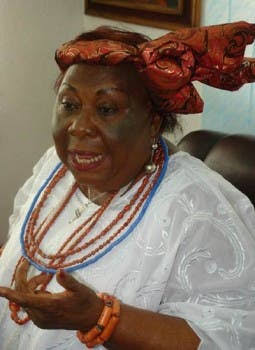
Chief Mrs. Rita Lori Ogbebor, The Igba of Warri

In another salvo that seemed to capture the worries, yearnings and aspirations of the people, Chief Rita Lori-Ogbebor, the Igba of Warri, fired as follows via her “Voice of Itsekiri Women”: –

“Already, the women of our land have noticed the maneuver by groups who want to take over the soul of our nation. They and their outside backers are daring to want to install a puppet king that they can push around to give them contracts from government and companies. They did this to the late king. Before he could hardly settle down on his throne, he was taken to Abuja and Sokoto. On that occasion, I phoned and told them that what they were doing was unacceptable to the Itsekiri and that they should return the king to his land, the land of his ancestors, where he reigns over his people. He is not a king for contractors or for seeking (political) party positions for people.

One of the prominent groups is that of the so-called “Twelve Disciples”. This is a cabal that, like cancer, has eaten into the body of the Itsekiri nation. Like cancer, it has eaten the fabric of the society economically and socially. This group is headed by Ejele. Ayiri is the go-getter and the daring one who will do anything to get whatever he wants. They have scared everybody who has any intelligence and who dares to show his face in or any interest about Warri and environs. People have run away for their dear lives because they will kill and burn down houses if there is the need.

The cabal has reached the palace, the soul of the Itsekiri nation. The iroko tree has fallen. Backed by outsiders who claim to be Itsekiris, they are now prepared to take over the throne and take over our souls. This is the story today and Itsekiris should know it. By the Grace of the Almighty, the Creator of the Itsekiri people, the Itsekiris will fight to install a king who has the following qualities –

  • He must be eligible and SUITABLE
  • He must be mature in mind and character
  • He must be economically stable and independent
  • He must not be known to be a user of any illicit or hard drug
  • He must be able to unify the kingdom and must be seen as a potential unifier and rallying point
  • He must be of good and stable character, pedigree, and credibility
  • He must be fluent in Itsekiri language and conversant with basic Itsekiri traditions, norms, and customs
  • He must have the ability to harness the kingdom’s vast human talents for the benefit of all.

Anything short of these will be unacceptable and will spell doom for our kingdom. We shall hold our land. The Itsekiri people, the youths, should now forget money and fight for their souls and for their children yet unborn – to be Itsekiri again, in the proper setting of being an Itsekiri. They should fight for their lands that are being ceded by this cabal for positions in the senate and federal government. For example, lands are being ceded in Warri North Local Government by Ejele and Godwin Ebosa. Their reason is that they want peace. Warri South West was ceded by Chief Ibori and Uduaghan under the pretense of wanting peace. Different parts of Warri South have been taken over by our neighbors in the name of peace. Shall we not fight naked rather than die naked? This is the question Itsekiri youths should ask themselves.

I talk as an old woman and a mother who has been fighting. I fight as a woman who saw this coming 30 years ago. You can see for yourself. They have gotten into the palace to take over our throne and bastardize it. The only pride of the Itsekiri man or woman is our culture and inheritance, which we must fight to preserve till the very end.”

With that patriotic salvo, fired by the power of woman, everything quickened. From a sluggish rhythm since December 2020, affairs hastened to a hurried pace. After a series of meetings and altercation between the camps of Pa Akoma and Prince Emmanuel Okotie-Eboh, the ruling house finally announced the latter, a son of Nigeria’s first republic’s Minister of Finance, as the Olori Ebi and regent to preside over the affairs of the Kingdom until the Ogiame recovers and returns to his throne or a successor is enthroned. In response to the Ologbotsere’s formal request to the ruling house to present a candidate to the Ojoye-Isan (the traditional advisory council to the Olu headed by the Ologbotsere himself as the most senior chief, the ruling house embarked on a selection process in which they considered the eligible princes in consult with the Ifa Oracle for confirmation. In a video clip circulated on social media, one of the chief priests of the oracle consulted swore by the gods that Tsola (Prince Utieyinoritsetsola Emiko) was the oracles’ choice. He affirmed that some twelve others were rejected for various reasons and that there was a warning that the kingdom will be destroyed if a particular candidate was forced on the people. So, swearing by the Egbejugbele deity, he said they then consulted with the name of the one that was chosen. He said he did not know him and had never met him. He cautioned the nation on the influence of money and declared that if the kingdom accepts the chosen prince, normalcy and progress would be restored in the kingdom. He further disclosed that one of the candidates would die if he is forced on the people. So, satisfied, the ruling house presented the chosen one, Prince Utieyinoritsetsola Emiko, a nephew of the reigning Olu and son to the immediate past Olu, Ogiame Atuwatse II. But lo and behold, the Ologbotsere, citing a 1979 edict that prescribes procedures and conditions for ascension to the throne, disqualified the chosen prince. The ruling house made it clear that the Ologbotsere had no such power and in a swift and unprecedented reaction, formally suspended him from that office and role forthwith. The Iyatsere who is next in line to the Ologbotsere stepped in and the pace quickened further.

Come April 5 2021, the Alejefun ceremony (traditional rite to announce the death of the monarch) was performed in the palace at Ode Itsekiri, the traditional headquarters of the kingdom, and Prince Utienyinoritsetsola Emiko was presented as the Omoba, successor to the throne of the Olu of Warri.

The Omoba, Prince Utieyinoritsetsola Emiko Being Presented to the Itsekiri by Chief Atserunleghe, the Iyatsere of Warri Kingdom

A now aggrieved Ayiri Emami, the suspended Ologbotsere, decided to challenge his suspension and the choice of Omoba in court. His grouse? As next to the Olu, the ruling house had no power to suspend him, he claimed. Only the one with the power and authority to appoint has power to suspend or remove him from office, he was reported to have opined. And as for the Omoba, he put his foot down that his mother is neither of Itsekiri nor Edo stock, as decreed by the 1979 edict, but a Yoruba!

Meanwhile the march to coronation day had begun under the leadership of the Iyatsere. The Iken rites were carried out by the Omoba and some 21 communities of the kingdom came out in solidarity to perform all day for two weeks in a row in honor of the departed king after his remains were formally interred at the royal cemetery in Ijala. The Omoba had, after the Iken rites, proceeded to Idaniken, a ninety-day seclusion prior to his coronation as king. And a coronation date of 21st August 2021 had been announced. Seeing the trajectory of events, and as the caliber of the Omoba began to show through, some who were reportedly against him began to decamp to his side unabashedly. Asked why the Omoba was chosen, Yemi Emiko, himself a prince and uncle to the Omoba, had this to say: 

“He is the most qualified – stable character, strong mental capacity, clear understanding of the sensitivities of our people, deep, calculated thought processes, and skillful analytical mind on kingdom matters. There was simply no serious competition around him this time around.”

This notwithstanding, and besides the confirmation of the Oracle, there were still some persons who, many suspect for reasons of personal aggrandizement, cast aspersions on the selection process and outcome.

Among such were the suspended Ologbotsere and his supporters. Apparently miffed at the progress being made towards the coronation of the Omoba, they sought for some dramatic means to stall the process. By the way, by now the courts had miraculously embarked on their routine holidays and the cases before them were thus redundant, at least for the time being. So, out of the blues came the prince that was “smuggled” in from London on social media dressed as Omoba. A couple of days later, those beating the drums to which he was dancing showed up on an Arise TV program in the person of a self-styled spokesman of the Ologbotsere Descendants announcing to an increasingly baffled world that there were two Omoba. They argued like sounding brass that the Omoba that recently surfaced on social media met all the conditions stipulated by the 1979 edict whilst Prince Utieyinoritsetsola did not because his mother is Yoruba. For balance, Arise TV invited the duo of Chiefs Mene Brown and Ariyo to air the position of the other side a day or two later. The hitherto baffled audience must have heaved sighs of relief as these chiefs straightened the records and facts that had been badly mangled in the preceding show, including the fact that the Itsekiri people are themselves of Yoruba stock and as such there could be no question as to the matrimony of the prince that has been chosen to ascend to the throne.

Before this last desperate attempt to stall the process leading to the coronation, some person(s) had broken into the royal chamber in which the crowns of the king and other regalia are secured, and removed the key crown, a silver crown said to be 410 years old and had adorned the heads of the fourteen previous Olus, in a bid to frustrate the coronation of the Omoba. The police had been investigating the matter and at a point the suspended Ologbotsere was invited for questioning but nothing had come of the investigations. So, the issue about what crown will be used for the coronation began to worry the minds of an empathetic and prayerful citizenry even as they wondered how the issue of the contending “Omoba” on social media will be resolved.

Events soon came to their aid. The coronation program was formally announced by the Iyatsere thus allaying fears about the matter of the crown. There must be a befitting crown for a coronation to take place. And then the police put out a notice for the arrest of two princes in connection with the theft of the crowns – Prince Oyowoli Emiko, the contending prince on social media and in court, and his brother, Prince Omatsuli Emiko, both of them sons of the immediate past Olu, Ogiame Ikenwoli. The misguided princes had been thrown under the bus by those who sponsored them on the path of dishonor in furtherance of their own selfish interests. Whilst these sponsors are free out there today in the wilderness they have created for themselves, the unwary princes have become fugitives!

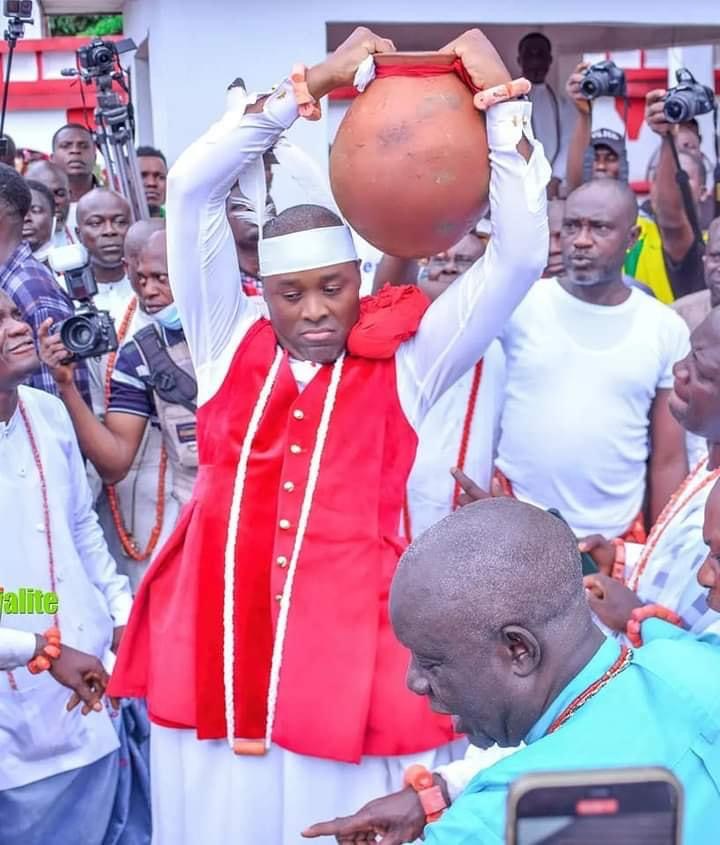
The Omoba Performing one of the Final Symbolic Rites Before the Coronation

And so D-Day arrived. 21st August of the year 2021 and the coronation of the 21st Olu of Warri. Messages of good will and solidarity poured in from far and near. A melody specially crafted by the choir of the Queen Mother’s church to commemorate the event had been in the air for weeks already. Citizens adorned in colorful and specially made attires for the occasion trooped out in their tens of thousands. Canoes and boats colorfully and fabulously decorated pulled out into the Warri River at dawn for the spectacular splendor that is the traditional regatta. A 2021 customized Rolls Royce, a Bentley, also customized, and a private jet, had in the preceding week graced the social media space as souvenirs the Omoba had gifted himself to mark the occasion. As the Warri Kingdom was upbeat in joyous celebrations, so was Itsekiri in diaspora. Families, societies, associations, individuals and friends, found one way or the other to be part of the celebrations wherever they were. Several TV stations, including the popular Arise TV and Channels TV, broadcast the day-long event live.

And then all on ground in Warri and elsewhere in the world, thanks to social media technology, saw him who shall soon be crowned the 21st Olu of Warri as he was ushered into his royally adorned boat at the Warri metropolis side of the Warri River. Other colorful boats lined up behind with drumming, singing, and dancing in an elegant procession to the traditional headquarters of the kingdom for the coronation rites and ceremony.

He fetched water, paddled a canoe, and hewed wood, all symbolically, for the last time. He would never be engaged in such menial tasks again. He was on the path to bear the kingdom on his shoulders and take on much more onerous and nobler responsibilities.

The Oni of Ife, His Royal Majesty Oba Adeyeye Enitan Ogunwusi, Ọjájá II with Ogiame Atuwatse III, Olu of Warri

In the specially built hall for the purpose of the coronation, filled to capacity, the Masters of Ceremony, celebrated broadcasters Alero Edun and Patrick Doyle, reeled out the names of dignitary after dignitary that came from far and wide to grace the occasion, welcoming them with befitting accolades. Most prominent amongst them were His Royal Majesty Oba Adeyeye Enitan Ogunwusi, Ọjájá II, the Oni of Ife; His Majesty King Dandeson Douglas Jaja Amayanabo of Opobo and Chairman Rivers State Traditional Council; eminent chiefs of the Benin Kingdom representing His Royal Majesty Oba Ewuare II, Ukuakpolokpolo, the Oba of Benin; His Royal Highness Alfred Achebe, Obi of Onitsha; Chief Gani Adams, Aare Ona Kakanfo of Yorubaland; Senator Omo-Agege, Deputy Senate President of the Nigerian National Assembly representing the President and Commander in Chief of the Armed Forces of the Federal Republic of Nigeria, His Excellency Mohammadu Buhari; His Excellency, the Governor of Delta State represented by his Chief of Staff, Mr. Festus Ovie Agas; His Excellency, Philip Shuabu, Deputy Governor of Edo State; His Excellency Alhaji Abubarkar Atiku Bagudu, Governor of Kebbi State; Alhaji Mordi Sheriff, former governor of Borno State, Mr. Festus Keyamo, SAN, Honorable Minister of State for Labor and Employment; Idris Wase, Deputy Speaker of the House of Representatives; Mr. Olumide Akpata, President, Nigerian Bar Association; Amaju Pinnick, President of the Nigeria Football Federation (NFF); etc., etc. …

The list went on and on.

Then it was time. The Omoba was being ushered into the hall but well ahead of him, a brand new throne, carried aloft by enthused youths, was brought in and positioned for the highlight of the event. On social media the throne was depicted thus: –

“Those that built the new Ogiame’s customized stool also sent a voice directory. The stool has an electronic detector. It is 80% raw gold and sapphire gemstones. Imported from Eastern Europe, the manufacturers and the cost have not been disclosed. However, it is being estimated at 3.5m Euros.”

The Olu’s Customized Stool

Seated on the new throne, the Omoba was royal equanimity personified. Then at exactly 3.30 p.m., after asking the Itsekiri nation for the third time if he should place the crown on the royal head, Chief Gabriel Awala, the Uwangue of Warri Kingdom, lowered the crown, a new golden crown, on Prince Utieyinoritsetsola Emiko to the joyful ululation (“hiii Iwo”) of the entire Itsekiri present in body or in spirit, and the Omoba transmuted to Ogiame Atuwatse III, the 21st Olu of Warri. It was the crowning moment of all that had transpired from the final days and dark hours of 2020 through the murky struggles in the dawn of 2021 to the glorious day that was 21st August. A golden crown had replaced the stolen silver crown, literally and figuratively! And a new era was born for the Itsekiri people, the Warri Kingdom. All Glory be to the Most High!

Former President Olusegun Obasanjo called to pay Homage
Solidarity Visit by His Excellency Abdullahi Umar Ganduje, OFR, Governor of Kano State
Former President Goodluck Ebele Jonathan on a solidarity visit and paying homage to the new king.
And the Honorable Minister of the Niger Delta promising to build the Escravos-Warri Road
Speaker of the House of Representatives, Honorable Femi Gbajabiamila {Left] paying homage and the Minister for the Niger Delta [Right]